
24 Jul Pickleball Injuries: How to Stay in the Game — and When to See an Orthopedist
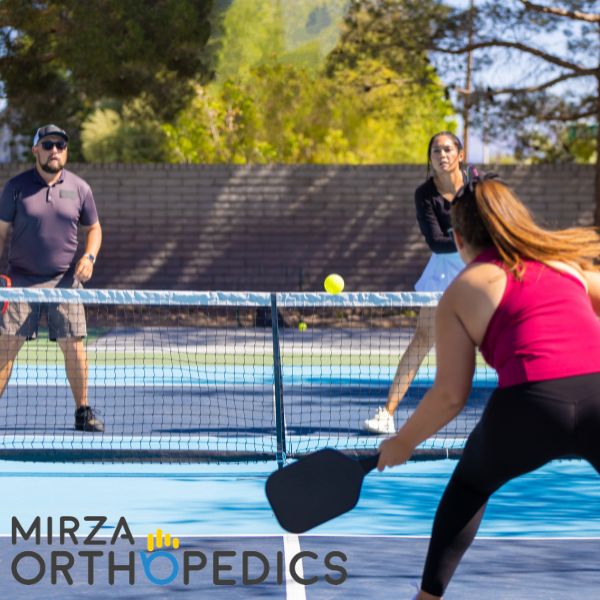
Pickleball is the fastest-growing sport in the country, and Long Island has embraced it as fully as anywhere. New courts keep appearing across Suffolk County — in parks, converted tennis courts, and dedicated clubs — and players of every age are discovering how quickly a casual game becomes a genuine workout. Nationally, participation jumped more than 150% in just two years, and it hasn’t slowed since.
With that surge has come a quieter trend that orthopedic surgeons see every week: a rising number of pickleball injuries. The sport is easy to learn and gentle on the lungs, but it asks a lot of the joints — quick pivots, sudden stops, overhead swings, and the occasional off-balance scramble toward the net. At Mirza Orthopedics in Smithtown, many of the hand, wrist, elbow, and shoulder injuries we treat now trace back to a pickleball court.
Here’s what players should know about the most common injuries, how to lower their risk, and when a nagging ache is worth a visit to a specialist.
Why Pickleball Sends So Many Players to the Orthopedist
Pickleball’s appeal — a short learning curve and a smaller court — is also part of the injury story. The compact court rewards fast lateral movement and quick reaction, and a large share of players are 50 and older, an age when bones are less forgiving and balance takes a little longer to recover.
The data backs this up. Studies of pickleball injuries treated in U.S. emergency departments consistently find that fractures and sprains are the most common problems — and that the vast majority happen to players aged 50 and older. As the sport’s popularity has surged, injuries have climbed right alongside it. Just as telling is how they happen: falls, more than collisions or gradual overuse, are behind many of the most serious cases.
The encouraging news: most pickleball injuries are treatable, and many are preventable. Knowing where the risk concentrates is the first step.
The Most Common Pickleball Injuries
Wrist fractures — the number one pickleball injury
If there’s a signature pickleball injury, it’s the broken wrist. When a player loses balance — often backpedaling for an overhead — the instinct is to catch the fall with an outstretched hand. Orthopedic surgeons call this a FOOSH injury (falling on an outstretched hand), and it channels the full force of the fall straight into the wrist.
In studies focused on hand and wrist trauma, the wrist is by far the most commonly injured area, and fracture is the most common diagnosis — with wrist fractures alone accounting for roughly half of all pickleball hand-and-wrist injuries. The overwhelming majority of falls result from a fall. Women over 55 are especially vulnerable, in part because of age-related changes in bone density.
A wrist fracture is not something to “walk off.” Prompt evaluation ensures the bones are aligned and healing correctly, which protects your long-term grip, motion, and strength. (Learn more about how we treat wrist injuries.)
Pickleball elbow (tennis elbow)
“Pickleball elbow” is the sport’s nickname for lateral epicondylitis — the same overuse condition tennis players know well. Repetitive gripping and the snapping motion of a paddle stroke irritate the tendons on the outside of the elbow, producing pain that can radiate down the forearm and make everyday tasks like lifting a coffee cup surprisingly uncomfortable.
It tends to build gradually rather than arrive with a single dramatic moment, which is exactly why players ignore it for too long. Early treatment — rest, technique adjustments, bracing, and targeted therapy — usually resolves it without surgery, but persistent cases deserve a specialist’s attention. (See our approach to elbow injuries.)
Rotator cuff and shoulder injuries
The overhead serve and repetitive swinging that make pickleball fun also stress the shoulder. Rotator cuff strains and tears, along with impingement, are among the most common diagnoses among players presenting with shoulder pain. Some develop slowly from repetitive motion; others happen suddenly during an aggressive overhead or a fall.
Shoulder pain that lingers beyond a few days, weakens your arm, or disrupts your sleep is worth evaluating — rotator cuff problems generally respond best when they’re addressed early. (Explore treatment for shoulder injuries.)
Hand and finger injuries
Jammed and sprained fingers, ligament injuries, and fractures of the hand are common when players fall or take a ball off the fingertips. These injuries are easy to dismiss as minor, but an untreated finger fracture or ligament tear can lead to lasting stiffness and reduced function. If a finger is swollen, crooked, or won’t bend normally, have it checked. (More on hand injuries.)
Knee injuries
The court’s constant start-and-stop and side-to-side movement puts real demand on the knees. Meniscus tears, ligament sprains, and aggravated arthritis all show up in pickleball players, particularly when a pivot goes wrong. Knee pain with swelling, instability, or a catching or locking sensation should be evaluated rather than pushed through. (Learn about knee injuries.)
A note on lower-leg injuries: Achilles and calf injuries also occur in pickleball, often felt as a sudden “pop” during a push-off. These deserve prompt evaluation too — don’t assume a sudden calf or heel injury is just a cramp.
Why Older Players Face a Higher Risk
Pickleball’s popularity with active adults is wonderful for fitness and community, but it does concentrate injuries in an age group whose bodies are less tolerant of a hard fall. Bone density naturally declines with age, so a fall that might bruise a younger player can fracture an older one. Reaction time and balance also change over the years, which increases the odds of an awkward backpedal or a missed step.
None of this is a reason to stop playing — it’s a reason to play smart.
How to prevent pickleball injuries
A few habits meaningfully lower your risk:
- Warm up before you play. Five to ten minutes of light movement and dynamic stretching prepare muscles and tendons for quick starts and stops.
- Wear real court shoes. Running shoes are built for forward motion, not the lateral movement pickleball demands. Court shoes provide the side-to-side support that helps prevent ankle rolls and falls.
- Don’t backpedal for overheads. Turning and shuffling to reposition — rather than walking backward — is the single best way to avoid the falls that cause wrist fractures.
- Check your paddle grip. A grip that’s the wrong size or a paddle that’s too heavy increases strain on the wrist and elbow. If you’ve had hand or wrist trouble, choose a lighter paddle and a properly sized grip.
- Build strength and balance off the court. Simple strengthening and balance work improves stability and help your body absorb the sport’s demands.
- Respect early warning signs. Soreness that lingers, weakens a joint, or returns every time you play is your body’s way of asking for attention.
When Should You See an Orthopedist?
Minor aches often settle with a few days of rest and ice. But some signs point to an injury that won’t heal well on its own. Consider seeing a specialist if you have:
- Pain, swelling, or deformity after a fall (especially at the wrist)
- Inability to bear weight, grip, or fully move a joint
- Pain that persists beyond a week or keeps returning with play
- Weakness in the arm or shoulder, or pain that disrupts sleep
- A joint that catches, locks, gives way, or feels unstable.
- A sudden “pop” followed by pain or swelling
Getting the right diagnosis early often means simpler treatment and a faster, more complete return to the court.
Getting Back in the Game with Mirza Orthopedics
At Mirza Orthopedics, we focus on upper-extremity injuries — hand, wrist, elbow, and shoulder — as well as knee injuries, using advanced techniques to help patients return to the activities they love. Whether you’re dealing with a wrist fracture from a fall, stubborn pickleball elbow, or shoulder pain that won’t quit, our team builds a treatment plan around your goals, favoring the least invasive path that will give you a durable result.
Serving Smithtown and Long Island, we make it easy to be seen quickly so a minor injury doesn’t become a lasting problem. If pickleball has left you hurting, don’t play through it — call us at (631) 361-5302 or request an appointment online, and let’s get you back on the court.
Frequently Asked Questions
What is the most common pickleball injury?
Wrist fractures are the most common serious pickleball injury, usually caused by falling onto an outstretched hand. Sprains, strains, and “pickleball elbow” are also very common.
What is pickleball elbow?
Pickleball elbow is another name for tennis elbow (lateral epicondylitis) — an overuse injury of the tendons on the outside of the elbow, caused by repetitive gripping and swinging. It usually responds well to non-surgical treatment when addressed early.
Is pickleball safe for people over 50?
Yes. Pickleball is a great way to stay active at any age, but players over 50 are more prone to fall-related fractures. Proper footwear, a warm-up, avoiding backpedaling, and strength and balance work all reduce the risk.
How do I know if my pickleball injury needs a doctor?
See an orthopedist if you have swelling or deformity after a fall, can’t move or bear weight on a joint, have pain lasting more than a week, or notice weakness, instability, or a joint that catches or locks.
Do I need surgery for a pickleball injury?
Most pickleball injuries are treated without surgery. When surgery is needed — for certain fractures or tears — modern techniques are designed to restore function and get you back to activity as smoothly as possible.


